
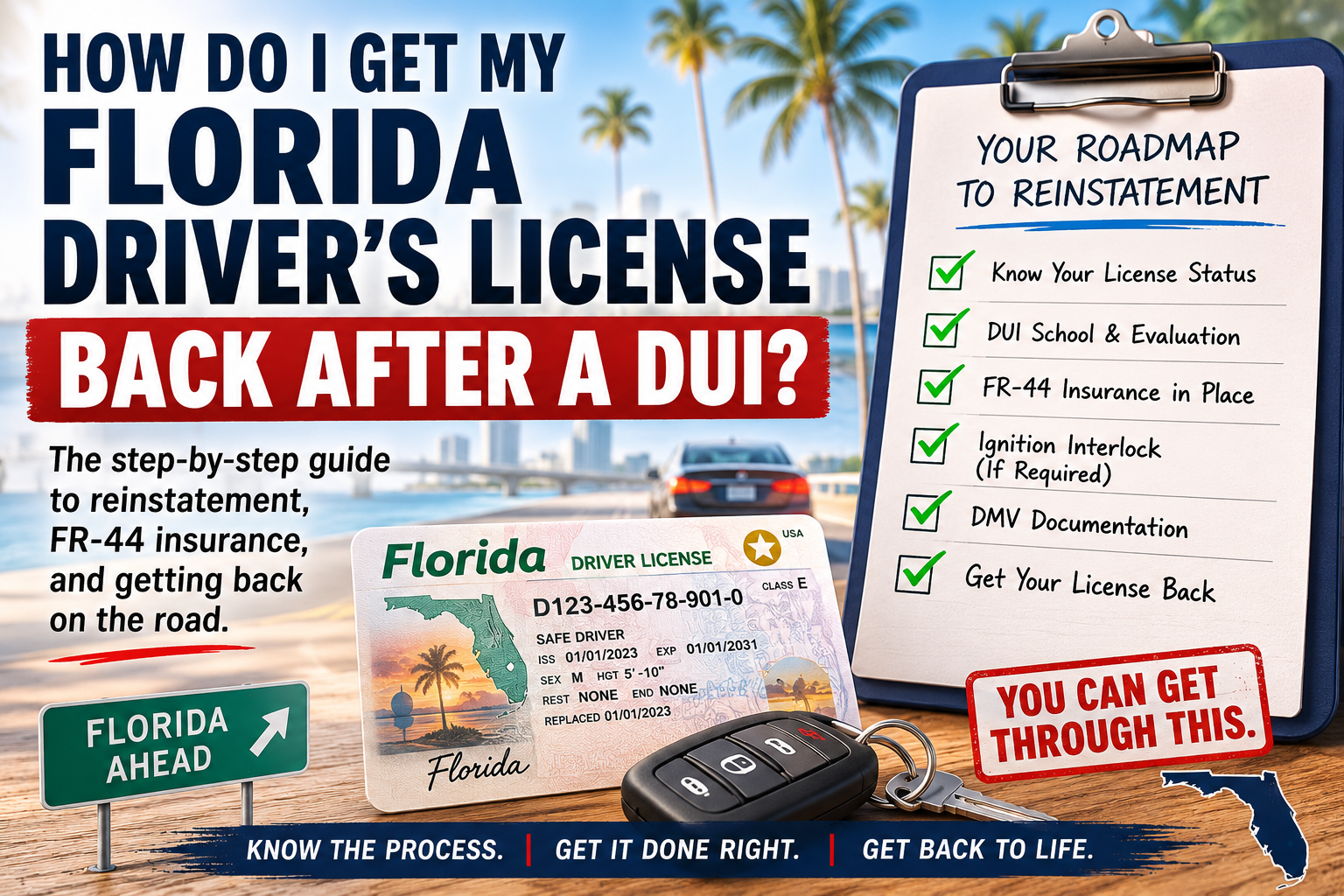
Quick answer: There’s a specific order that can keep this from turning into three or four trips to the DMV: understand your license status first, take care of DUI school and evaluation requirements, get your FR-44 insurance set up before your DMV visit, install an ignition interlock if your case requires one, and have an agent available who can send FR-44 verification directly to the DMV if their system hasn’t caught up yet. Get the order right, and much of this can line up on the same day.
If you’ve had a DUI in Florida, you already know this part — everything seems to hit you at once.
You’re told you may need an ignition interlock device. You’re told you need FR-44 insurance. You’re told you might qualify for a hardship license. And somewhere in there, the DMV tells you to come back when everything is ready.
So what do you actually do first? Buy a car? Get insurance? Install the interlock? Just walk into the DMV and hope for the best?
I talk to Florida drivers in this exact situation every day. The good news is that there is an order to follow. Once you understand it, you’re much less likely to spend your time running in circles or guessing your way through the process.
Let’s walk through it.
Step 1: Know Where You Actually Stand
Before anything else, you need to know three things:
- Your DUI conviction date
- How long your license is suspended or revoked
- Whether you’re currently eligible for a hardship license or full reinstatement
Usually, this information comes from your court paperwork, your attorney, or directly from the Florida DMV.
If you’re not sure, that’s the first thing to straighten out — before worrying about the insurance company or the interlock provider. Everything that follows depends on knowing exactly where you are in the suspension and reinstatement process.
Keep your DMV paperwork, too. That sounds simple, but it matters. If you’ve lost the original suspension letter, finding the information you need may be more difficult than you expect. I explain what I’ve been seeing and what to do in How Do I Find My Florida FR-44 Case Number? What Works Now.
Step 2: Take Care of DUI School and Evaluation
Depending on your case, Florida may require DUI school, a substance-abuse evaluation, treatment or counseling, and other conditions before your driving privilege can be restored.
Make sure you know exactly what applies to your case and have documentation showing enrollment or completion when required.
This is also where I always remind people that I’m an insurance agent, not a DUI attorney. Questions about your criminal case, legal deadlines, or what a court has ordered belong with your attorney. My part of the process is helping you understand what happens on the insurance and FR-44 side once those requirements start coming together.
And that’s often the part nobody explains very well. I wrote about that separately in What Happens After a Florida DUI?.
Step 3: Understand What the FR-44 Actually Is
A lot of people picture the FR-44 as some kind of separate insurance policy.
It isn’t.
An FR-44 is a financial-responsibility filing connected to qualifying insurance coverage. It tells the State of Florida that you are carrying the higher liability limits required for your situation and creates an ongoing reporting relationship between the insurance company and the state.
For someone who is required to maintain an FR-44 as a condition of reinstatement or continued driving privileges, getting the filing right — and keeping it right — is critical.
And here’s another part people don’t always hear clearly the first time: your insurance situation can look very different depending on whether you own a car, don’t own a car, live with other drivers, or are between vehicles.
That’s why I don’t like treating an FR-44 as a commodity you simply buy online and forget about. The policy has to fit the actual situation.
Step 4: Get Your FR-44 in Place Before You Walk Into the DMV
This is where the order really matters.
If you’re approaching a hardship-license appointment or full reinstatement and your case requires FR-44 proof, you generally want the insurance and filing arranged before you arrive at the DMV — not something you’re trying to figure out while standing at the counter.
In practice, this is what I do with my clients:
We talk through the situation — car or no car, household drivers, work schedule, budget, reinstatement date and any deadlines.
I quote the appropriate policy with the required coverage and FR-44 filing.
We put the coverage in force and submit the filing.
That’s the straightforward part.
Here’s where people sometimes get tripped up.
The DMV’s records and the insurance company’s records don’t necessarily update at exactly the same moment. If your FR-44 was just issued, the DMV may not immediately see the filing in its system.
That’s why I want to know when one of my clients is going to the DMV.
If there is a verification problem while you’re standing there, I want you to be able to call or text me. If the DMV needs proof sent directly from the insurance side, I can work with the office and the insurance company while you’re there instead of leaving you to figure it out alone.
That’s a small part of what an experienced FR-44 agent does, but it can make a very big difference on reinstatement day.
Step 5: The Ignition Interlock — Timing Matters Here Too
If your case requires an ignition interlock device, make sure you understand exactly when it must be installed and what documentation the DMV requires.
For many drivers, the process means contacting an approved interlock provider, having the device installed in the vehicle they will be driving, obtaining proof of installation, and bringing the appropriate documentation to the DMV.
Don’t assume the interlock can simply be handled later.
The exact requirements depend on your case, so verify them before your DMV visit. The goal is to arrive with every requirement satisfied rather than discovering one missing piece after you’ve already waited in line.
Step 6: Walk Into the DMV With Everything Lined Up
By the time you go to the DMV, you want your documentation organized.
Depending on your individual case, that may include:
- DUI school enrollment or completion documentation
- Evaluation or treatment documentation, if required
- Court or DMV paperwork
- Ignition-interlock documentation, if required
- Active insurance with the required FR-44 filing
- An insurance agent who can be reached if the DMV needs additional verification
When everything is lined up correctly, the reinstatement process can be dramatically smoother.
The difference between one successful DMV visit and several frustrating trips often isn’t that someone intentionally did something wrong. It’s that nobody explained the entire process beforehand.
And even after your license is reinstated, pay attention to what happens next. Florida’s newer driver-license numbering system can create an unexpected mismatch between the number originally associated with the insurance policy and a newly issued license number.
I’ve already seen that happen to a client whose license was reinstated and then suspended again even though the FR-44 insurance remained active. I explain the situation — and the extra step I’m now taking with clients — in Why Was My Florida Driver’s License Suspended Again?.
A Few Situations I See All the Time
“I don’t even have a car yet.”
That doesn’t necessarily prevent you from beginning the process. Depending on your circumstances, a properly structured non-owner policy may be an option. If an ignition interlock is required or you have regular access to a vehicle, however, the situation may be different. That’s why I want to understand the entire household and vehicle situation before recommending a policy.
“I already have a car and insurance, but no FR-44.”
In some situations, an FR-44 can be added to existing coverage once the policy meets the required limits. In others, replacing the policy may make more sense. The important part is coordinating the change correctly and avoiding an unintended lapse.
“I’m trying to time everything around my court date or DMV appointment.”
This is where experience matters.
I’ve been in the insurance business since 1987, and FR-44 cases have taught me that small timing details can create surprisingly large problems. Tell me the dates you’re working with and I’ll help you understand what needs to happen on the insurance side and when.
Getting the License Back Is Only the Beginning
One thing I want drivers to understand is that reinstatement day isn’t necessarily the end of the process.
Once your FR-44 requirement is active, maintaining continuous coverage becomes extremely important. A cancellation, missed payment, incorrect filing, insurance-company change, or DMV verification problem can create another license problem later.
Carrier rules can also change over time. That’s why I’ve kept updates such as Has Progressive Changed Its Florida FR-44 Rules? and Can Bristol West’s Excluded Driver Option Lower FR-44 Costs? available as archived reference material while clearly reminding readers to verify current underwriting rules before relying on an older carrier update.
Even an outside event that has nothing directly to do with your DUI can become a compliance problem if it causes your policy to lapse. I discussed that practical issue during a federal shutdown in Does a Government Shutdown Affect Car Insurance?. The shutdown-specific information may become dated, but the larger lesson doesn’t: when an FR-44 is involved, protect the continuity of the policy.
Florida’s DUI laws can change as well. For example, Florida changed the consequences associated with refusing certain testing beginning October 1, 2025. I explain the change and where the insurance side fits into it in Did Florida Change the Rules for DUI Refusals?.
How I Handle This With Clients
We talk first.
I want to understand your reinstatement timeline, vehicle situation, household, work schedule and budget before we decide what insurance arrangement makes sense.
Then we set up the appropriate FR-44 coverage and filing for your situation.
We talk about the order — insurance, interlock if required, DMV documentation and reinstatement — so you’re not guessing your way through it.
And when you’re going to the DMV, I want you to have my number with you.
If there’s an insurance-verification problem at the counter, call or text me. You’re already dealing with enough. You shouldn’t have to become an expert in insurance-company and DMV communication while you’re standing in the lobby.
The Bottom Line
Getting your Florida driver’s license back after a DUI isn’t one single step.
It’s a sequence.
You need to know your license status, understand your court and DMV requirements, complete the required DUI education or evaluation, arrange the correct insurance and FR-44 filing, handle an ignition interlock if your case requires one, and arrive at the DMV with the right documentation.
More importantly, you need to keep everything coordinated after the license comes back.
That’s why I look at FR-44 insurance as part of a process rather than simply another insurance policy.
If you want someone to walk you through the insurance side of that process, set up the FR-44 correctly, and be available when you’re dealing with the DMV, call or text me directly.
We’ll figure out where you are and what needs to happen next.
Florida FR-44 Insurance Resource Guides
Understanding Florida FR-44 Insurance — Start here if you’re new to all this. What an FR-44 actually is, why Florida requires it, and how it’s different from a normal insurance policy.
License Reinstatement and FR-44 Compliance — Getting your license back, staying compliant once it’s filed, and avoiding the lapses, missed payments, and mistakes that lead to another suspension.
Florida FR-44 Insurance Companies and Rates — What actually moves your rate, where the real discounts are, switching carriers the right way, and what an FR-44 costs over time.
Florida DUI Education and Consequences — What a DUI conviction actually triggers in Florida, from license suspension through the FR-44 requirement itself.
Beyond DUI — Related situations that come up along the way: moving in or out of Florida, household questions, and how Florida’s rules compare to other states. (Coming soon)
Florida Auto Insurance — Back to the main site for general Florida auto insurance guidance beyond FR-44.
Continue Reading About License Reinstatement & FR-44 Compliance
- How Do I Get My Florida Driver’s License Back After a DUI? (This article) — The complete step-by-step guide to coordinating your FR-44, DUI requirements, ignition interlock and DMV reinstatement.
- Why Was My Florida Driver’s License Suspended Again? — Common reasons a reinstated Florida license gets suspended again, including a verification mismatch that can happen even when the insurance never lapsed.
- How Do I Find My Florida FR-44 Case Number? What Works Now — What to do when you’ve lost your suspension paperwork or can’t find the case information needed for reinstatement.
- Did Florida Change the Rules for DUI Refusals? — What changed under Florida’s newer DUI-refusal law and where license suspension and FR-44 requirements fit into the picture.
- Can Bristol West’s Excluded Driver Option Lower FR-44 Costs? (Archived) — A carrier-specific update about excluded drivers on Florida FR-44 policies; retained for historical reference.
- Has Progressive Changed Its Florida FR-44 Rules? (Archived) — A historical update on Progressive’s FR-44 payment and filing rules; verify current options before relying on older carrier information.
- Does a Government Shutdown Affect Car Insurance? (Archived) — Why financial disruptions and missed insurance payments can become much more serious when continuous FR-44 compliance is required.
About the Author
Written by Clifford Schimek — Florida Auto & FR-44 Insurance Expert
I help Florida drivers every day with auto insurance quotes, FR-44 filings and the insurance side of license reinstatement. Reinstatement day is the one I pay the closest attention to, because it’s the day where a small timing gap between the insurance company’s records and the DMV’s records can cost someone an entire second trip. If you’ll tell me when you’re going, I’ll make sure I’m reachable. My goal is to make the process simpler and less stressful, and to give you a straight answer about what needs to happen next.
Clifford Schimek — Florida Auto & FR-44 Insurance Expert
Call or text: 305-796-2968
Learn More About Cliff
Why Clifford Schimek? – The case for working with me
Florida Auto Plus Insurance – Agency website
Florida FR-44 Information and Guidance – For Florida drivers who need an FR-44 filing
View my Google Business Profile – Reviews and business information