
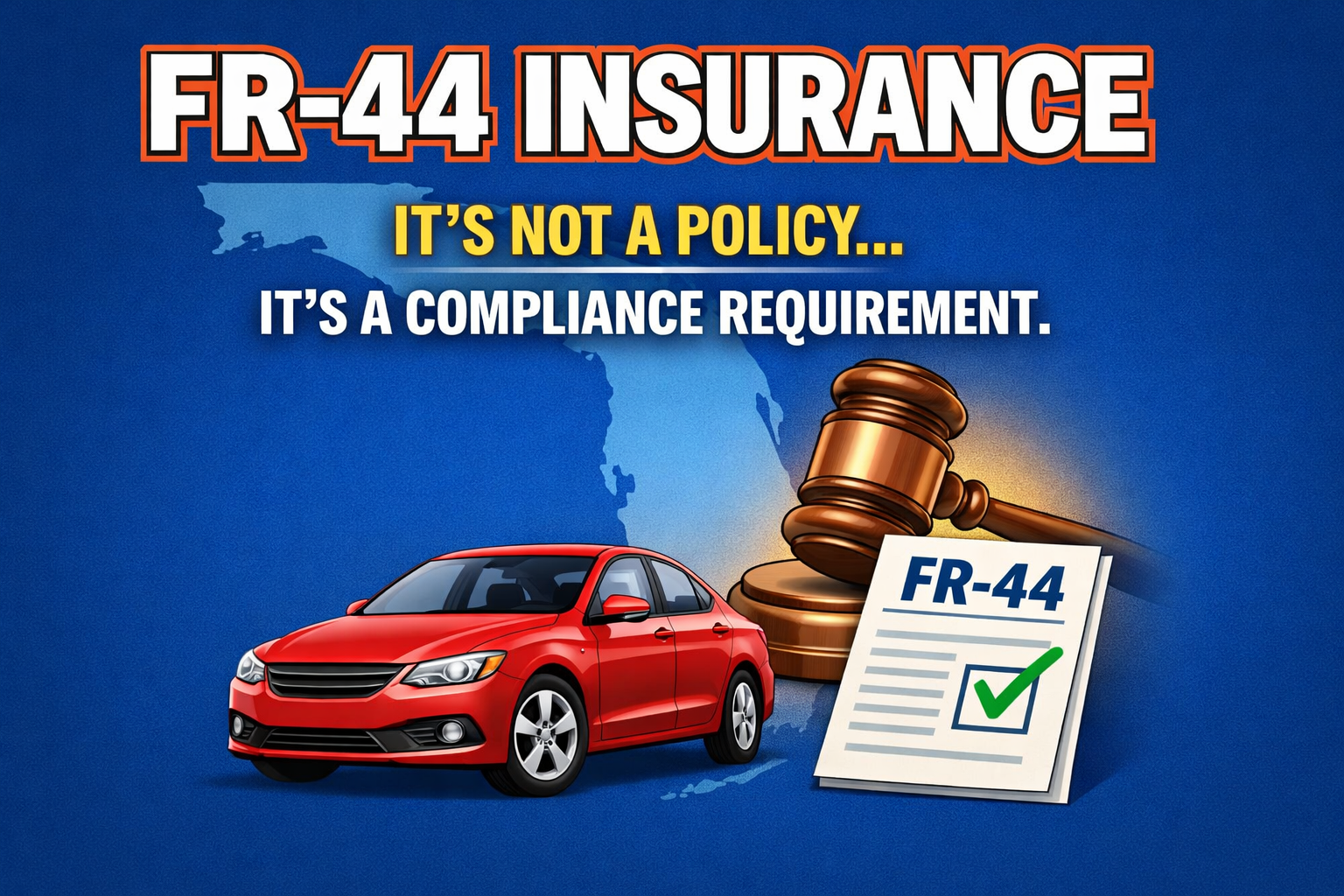
Quick Answer: Florida FR-44 insurance isn’t actually a special insurance policy—it’s a financial responsibility requirement ordered by the State of Florida after certain DUI convictions. To keep your driver’s license, you must maintain higher liability limits without any lapse in coverage until the state releases you from the requirement.
If you’re reading this, chances are you’re dealing with one of the most stressful situations a Florida driver can face.
Maybe you’ve recently been convicted of a DUI.
Maybe the Florida DMV told you that you need an FR-44 before your license can be reinstated.
Or maybe you’ve already purchased an FR-44 policy but you’re worried about making a mistake that could cause your license to be suspended all over again.
I’ve helped Florida drivers with FR-44 insurance for many years, and I’ve learned something that surprises almost everyone:
Buying an FR-44 policy is actually the easy part.
The real challenge is understanding the rules well enough to stay compliant until your requirement ends.
Unfortunately, that’s where many drivers get into trouble. I’ve spoken with people who believed they were finished, only to discover they still had months remaining. I’ve worked with drivers whose policies canceled because of a missed payment, forcing them to start the process all over again. I’ve seen people unknowingly violate their FR-44 requirement simply because no one explained how it really works.
That’s why I wrote this guide. Rather than answering just one question, this article explains the entire process—from the day you’re told you need an FR-44 until the day Florida finally removes the requirement.
What Is Florida FR-44 Insurance?
Let’s clear up one of the biggest misconceptions first.
FR-44 insurance is not an insurance policy.
Instead, it’s a certificate that your insurance company electronically files with the Florida Department of Highway Safety and Motor Vehicles (FLHSMV). That filing tells the state that you carry at least the minimum liability limits required after a qualifying DUI conviction. Those limits are significantly higher than Florida’s standard financial responsibility requirements.
The FR-44 filing serves one purpose: it proves to the State of Florida that you’re continuously maintaining the liability insurance required to keep your driving privilege.
Think of it as a compliance filing rather than a type of insurance.
Why Does Florida Require FR-44 Insurance?
Many people ask me why Florida doesn’t simply suspend a driver’s license and move on.
The answer is public safety.
A DUI conviction tells the state that the driver’s risk has increased. Rather than simply issuing another license once the suspension period ends, Florida requires drivers to carry substantially higher liability protection.
The goal isn’t punishment through insurance. The goal is to make sure that if another serious accident occurs, more financial protection is available for other people involved.
Whether someone agrees with that policy or not, understanding the purpose behind it helps explain why Florida monitors FR-44 compliance so closely.
Who Needs an FR-44?
Not every traffic offense requires an FR-44. Generally, Florida requires an FR-44 after certain alcohol-related DUI convictions. If the court or the Florida Department of Highway Safety and Motor Vehicles requires it, your license cannot be fully reinstated until the filing is in place.
If you’re unsure whether you need one, don’t guess. First and foremost, check the compliance requirement letter you received from the DMV — that’s the most direct confirmation of what’s required and for how long. You can also verify your status online through Florida’s DMV portal at mydmvportal.flhsmv.gov. Verify your requirement before purchasing coverage. Buying the wrong type of policy can delay getting your license back. If you already have a case and just need to track it down, see How Do I Find My Florida FR-44 Case Number? What Works Now.
What Does an FR-44 Actually Do?
This is another area where people become confused.
The FR-44 doesn’t increase your insurance protection by itself. The FR-44 filing simply tells Florida that your policy meets the state’s required liability limits.
Without that filing, your insurance policy alone isn’t enough. Likewise, having an FR-44 filing without an active insurance policy won’t satisfy the requirement either. Both pieces have to work together.
Getting Your License Back
For many drivers, purchasing an FR-44 policy is the final major step before license reinstatement. Once your policy is issued, your insurance company electronically files the FR-44 with the state. After the filing is accepted and you’ve completed any other reinstatement requirements, Florida can move forward with restoring your driving privilege.
Many people expect the process to happen instantly. Sometimes it does. Other times it may take additional processing time depending on your individual circumstances. That’s one reason I encourage clients to begin the process before they absolutely need to be driving again.
For a closer look at timing expectations around reinstatement itself, see How Do I Get My Florida Driver’s License Back After a DUI?. And if you want to know exactly what I walk clients through on day one, I wrote that up in What Should I Do When My Florida FR-44 Starts?.
The Journey, Start to Finish
Over the years I’ve found it helps clients to see the whole path laid out, rather than worrying about one step at a time:
- DUI conviction — the court or FLHSMV notifies you that an FR-44 will be required.
- License suspension — your driving privilege is on hold until requirements are met.
- FR-44 policy purchased — you secure coverage that meets Florida’s elevated liability limits.
- FR-44 filing submitted — your insurance company files the certificate electronically with the state.
- License reinstatement — once the filing is accepted and other conditions are met, your license comes back.
- The compliance period — the multi-year stretch where continuous, lapse-free coverage is what matters most.
- Requirement ends — Florida officially releases you from the FR-44 obligation.
Most drivers focus all their energy on steps 1 through 5. The truth is, step 6 is where the real work happens—and where most avoidable mistakes occur.
The Biggest Mistake Drivers Make
Here’s something I wish every Florida driver understood.
Many people think their job is finished once the FR-44 is filed. In reality, that’s when the compliance period begins. The next several years are what matter most.
During that time, Florida expects continuous insurance coverage. If your policy cancels… if your payment is missed… if your insurance company reports a lapse… you could find yourself facing another suspension—even though you’ve already worked so hard to get your license back.
I’ve unfortunately seen it happen. The good news is that it’s usually preventable once you understand the rules. I’ve written about exactly how this plays out in Why Was My Florida Driver’s License Suspended Again? and about the longer-term financial side of these slip-ups in The Real Cost of Florida FR-44 Insurance Over Time
Think of FR-44 as a Multi-Year Commitment
One way I explain FR-44 to clients is this: don’t think of it as buying insurance. Think of it as entering into a compliance agreement with the State of Florida. Your insurance company simply helps you satisfy that agreement.
Every payment matters. Every renewal matters. Every policy change matters.
The goal isn’t just to remain insured. The goal is to remain continuously compliant until Florida officially releases you from the requirement. That small difference in thinking can save drivers months—or even years—of frustration.
When Does the Requirement Actually Begin?
This is one of the questions I hear most often.
Many drivers assume the requirement begins on the date of their DUI arrest. Others believe it starts on the date they were convicted. In reality, what matters is when the State of Florida begins your FR-44 compliance requirement.
Because every case is a little different, I always tell drivers not to rely on assumptions or something they heard from a friend. I’ve seen people believe they only had a few weeks left, only to discover they still had several months remaining.
If you’re unsure about your compliance period, verify it before making any decisions about canceling your policy. It’s much easier to confirm your status than to fix another suspension. I go deeper on why the start date trips people up in When Should I Buy Florida FR-44 Insurance?
Can You Change Insurance Companies?
Absolutely.
Having an FR-44 does not lock you into one insurance company. In fact, many of my clients change insurance companies while they’re under an FR-44 requirement.
The important part is how you make the change. Your new policy should be active, and the new FR-44 filing should be accepted before the old policy is canceled. If there’s a gap between policies, even for a short period, Florida may treat that as a lapse in compliance.
That’s why I strongly recommend coordinating the transition carefully. Changing companies can save money. Creating a lapse can cost far more than you save. If you’re comparing quotes as part of that decision, Florida FR-44 Insurance Quotes: Five Things That Actually Move the Number and Do Insurance Companies Treat Florida FR-44 Drivers Differently?
What Happens If You Miss a Payment?
Life happens. People forget. Credit cards expire. Bank accounts change.
Unfortunately, the State of Florida doesn’t overlook an insurance cancellation simply because it was accidental. If your policy cancels for non-payment, your insurance company generally has an obligation to notify the state that your FR-44 filing is no longer valid. That can trigger another driver’s license suspension.
I’ve had clients call me in a panic because they didn’t realize one missed payment could have such serious consequences.
Whenever possible, enroll in automatic payments, keep your contact information current with your insurance company, and open every notice you receive. Those simple habits can prevent a major problem.
What Happens If Your Policy Is Canceled?
A cancellation doesn’t always happen because of a missed payment. Sometimes people decide they no longer need the policy. Sometimes they sell their vehicle. Sometimes they’re moving. Sometimes they’re shopping for lower rates.
Whatever the reason, if your FR-44 requirement is still active, canceling your policy without having another compliant policy already in place can put your driving privilege at risk.
Remember, Florida isn’t monitoring whether you own a vehicle. It’s monitoring whether you’re meeting the insurance requirement tied to your driving privilege. That’s a very important distinction.
What If You Sell Your Car?
Many people assume that selling their only vehicle means they no longer need insurance. For drivers without an FR-44 requirement, that may be true. For someone required to maintain an FR-44, it’s often a different story.
If you no longer own a vehicle but still have an active FR-44 requirement, a Florida non-owner FR-44 policy may allow you to remain compliant. I’ve helped many drivers make that transition without interrupting their compliance period. The important thing is to make the change correctly before canceling your existing policy.
What Is a Non-Owner FR-44 Policy?
A non-owner FR-44 policy is designed for drivers who need to satisfy Florida’s insurance requirement but don’t currently own a vehicle. It provides the liability coverage necessary for the FR-44 filing while allowing you to remain compliant.
It isn’t the right solution for everyone, but for many drivers it’s an affordable way to continue meeting the state’s requirements after selling a vehicle or during periods when they don’t own one.
Can You Move Within Florida?
Yes. Moving from Miami to Orlando, Jacksonville to Tampa, or anywhere else in Florida doesn’t eliminate your FR-44 requirement. However, your insurance premium may change because Florida insurance rates vary by location.
Whenever you move, notify your insurance company promptly so your policy information remains accurate. For city-specific pricing and requirements, I keep dedicated guides for:
Florida FR-44 Insurance by City
Tallahassee FR-44 Insurance — Looking for Tallahassee FR-44 insurance? While our dedicated Tallahassee FR-44 guide is coming soon.
Orlando FR-44 Insurance — Learn about insurance options and local considerations for drivers in the Orlando area.
Tampa Bay FR-44 Insurance — Find information specific to drivers throughout the Tampa Bay region.
Jacksonville FR-44 Insurance — Looking for Jacksonville FR-44 insurance? While our dedicated Jacksonville FR-44 guide is coming soon.
Miami FR-44 Insurance — Looking for Miami FR-44 insurance? While our dedicated Miami FR-44 guide is coming soon.
What If You Move Out of Florida?
This question is more complicated than most people expect.
Some drivers believe moving to another state automatically ends Florida’s FR-44 requirement. Unfortunately, that’s often not the case. Florida generally expects drivers to satisfy the requirement before considering it complete. Depending on where you move, you may still need to maintain insurance that satisfies Florida’s requirements.
Every situation is different, so don’t cancel your policy simply because you’ve moved. Verify your obligations first. If your move is taking you specifically to Virginia, that state has its own FR-44 rules worth understanding — see What’s the Difference Between Florida and Virginia FR-44?
Does FR-44 Affect Everyone in My Household?
No. The FR-44 requirement applies to the individual driver—not automatically to every member of the household.
However, the overall insurance policy, who owns the vehicles, who lives in the home, and who regularly drives the vehicles can all affect pricing. That’s one reason every situation deserves an individual review instead of relying on general advice online. I answer the household question directly in Do All the Cars in My Household Need FR-44?, and on the pricing side, Can I Still Get Discounts With Florida FR-44 Insurance? and Florida FR-44 Insurance Quotes: Five Things That Actually Move the Number cover what actually helps your premium.
Common Mistakes That Lead to Another Suspension
After doing this for as long as I have, I see the same handful of mistakes over and over. If you avoid these, you put yourself well ahead of most drivers I meet:
- Assuming the requirement is over on a “round number.” Three years is a common length, but it’s not universal. Confirm your actual end date with the state instead of counting on your fingers.
- Letting a policy lapse between insurance companies. Switching carriers is fine. Switching without overlap is what causes trouble.
- Ignoring renewal notices. A notice that looks routine can be the one that tells you a payment failed.
- Not enrolling in automatic payments. A single missed payment can undo years of clean compliance.
- Canceling coverage after selling a vehicle. Without a non-owner FR-44 in place first, this creates an immediate gap.
- Assuming a move out of state ends the requirement. It often doesn’t, and canceling on that assumption is one of the costliest mistakes I see.
- Not updating contact information. If your insurer or the state can’t reach you, you may not find out about a problem until it’s already a suspension.
- Shopping for a cheaper policy without coordinating the switch. Saving a little on premium isn’t worth risking a lapse.
- Not confirming the requirement has actually ended before canceling. This is the single most common way people accidentally restart the entire process.
- Going it alone without asking questions. Every case has small details that matter. Guessing is where most of these mistakes start.
When Does Your Florida FR-44 Requirement End?
This is one of the most important questions you’ll have throughout the entire process.
After making higher insurance payments for years, it’s natural to look forward to the day your FR-44 requirement finally comes to an end. But here’s my advice: never assume you’ve reached the finish line.
I’ve talked with drivers who believed their requirement had ended because someone told them it had been three years. Others thought it ended on the anniversary of their DUI arrest or conviction. The problem is that every case isn’t exactly the same.
The safest approach is to verify that Florida has officially released you from the FR-44 requirement before making any changes to your policy. Ending your coverage too early can create a lapse that may lead to another suspension. After working so hard to get your license back, it’s simply not worth taking that chance. I cover the general timeframes people ask about in How Long Do I Have to Carry Florida FR-44 Insurance?.
How Do You Verify You’re Finished?
Before canceling your FR-44 policy—or changing it to a standard Florida auto insurance policy—confirm that your requirement has officially ended. If you have questions, ask them before making changes.
A quick confirmation today can prevent weeks of frustration later. I’ve always believed it’s better to spend a few extra minutes verifying your status than spending months trying to fix an avoidable mistake.
You can check here: https://mydmvportal.flhsmv.gov/Home/en/PublicWeb/DLCheck
What I’ll Do for You
I don’t just sell FR-44 policies and send you on your way. Over the years, guiding clients through the entire compliance period has become just as much a part of my job as writing the policy itself.
Here’s what that looks like in practice:
- I help you confirm whether you actually need an FR-44 before you buy anything.
- I make sure your policy and your FR-44 filing are set up correctly the first time, so reinstatement isn’t delayed.
- If you want to switch carriers, I help coordinate the timing so there’s never a gap in coverage.
- If you sell your vehicle, I help you move into a non-owner FR-44 policy without interrupting your compliance.
- I encourage and help set up automatic payments so a missed bill doesn’t turn into a suspension.
- When you think you might be finished with your requirement, I help you verify that with the state before you cancel anything.
- And throughout, I’m the person you can call with a question instead of guessing or asking around.
After decades of doing this, I’ve found that the drivers who come out the other side without a hitch are almost always the ones who had someone in their corner answering questions before they made a decision—not after something went wrong.
The Good News
If you’re reading this while feeling overwhelmed, I want to leave you with some encouragement.
An FR-44 requirement doesn’t last forever. Thousands of Florida drivers complete it successfully every year. Most of them simply continue making their payments, avoid lapses in coverage, and stay informed throughout the process.
Eventually, the requirement ends. Life moves forward. The FR-44 becomes part of your past instead of your future.
Rates are also trending in drivers’ favor lately — see Florida FR-44 Drivers: Why 2026 Finally Looks Better.
Final Thoughts
An FR-44 requirement can feel intimidating at first. I’ve seen the frustration. I’ve heard the worry in people’s voices after they receive a suspension notice. I’ve helped drivers who weren’t sure where to begin, and I’ve also helped drivers who accidentally ran into problems because they didn’t fully understand the rules.
That’s why I believe education matters just as much as insurance. The more you understand about Florida’s FR-44 requirement, the easier it becomes to avoid costly mistakes and successfully complete the process.
If this guide helps you avoid even one unnecessary suspension or one expensive mistake, then it has done exactly what I hoped it would do.
Florida FR-44 Insurance Resource Guides
Understanding Florida FR-44 Insurance — Start here if you’re new to all this. What an FR-44 actually is, why Florida requires it, and how it’s different from a normal insurance policy.
License Reinstatement and FR-44 Compliance — Getting your license back, staying compliant once it’s filed, and avoiding the lapses, missed payments, and mistakes that lead to another suspension.
Florida FR-44 Insurance Companies and Rates — What actually moves your rate, where the real discounts are, switching carriers the right way, and what an FR-44 costs over time.
Florida DUI Education and Consequences — What a DUI conviction actually triggers in Florida, from license suspension through the FR-44 requirement itself.
Beyond DUI — Related situations that come up along the way: moving in or out of Florida, household questions, and how Florida’s rules compare to other states. (Coming soon)
Florida Auto Insurance — Back to the main site for general Florida auto insurance guidance beyond FR-44.
Continue Reading About Understanding Florida FR-44 Insurance
- What Is Florida FR-44 Insurance? A Complete Guide (This article) — Why an FR-44 isn’t a one-time insurance purchase, but a compliance requirement that has to stay active with no gaps for the full period.
- How Does an FR-44 Filing Work in Florida? — How your insurance company files the FR-44 with the Florida DMV, what the filing proves, and what happens after it is submitted.
- What Should I Do When My Florida FR-44 Starts? — What I walk every client through on day one, so nothing catches them off guard later in the process.
- How Long Do You Need FR-44 Insurance in Florida? — How Florida determines your FR-44 compliance period, when the clock begins, and why keeping continuous coverage matters.
- What Are the Most Common Florida FR-44 Questions? — Straightforward answers to the questions Florida drivers ask most often about FR-44 insurance and the reinstatement process.
- Does It Matter Who Handles Your Florida FR-44 Insurance? — Why the agent and agency handling your filing can matter as much as the policy itself.
- Can I Get Car Insurance After a Florida DUI? — Which types of insurance policies can satisfy Florida’s FR-44 requirement and how to choose the one that fits your situation.
- Why Does a Florida DUI Cost So Much? — Why the financial effects of a DUI often continue long after the court case is over, and what you can do to manage them.
- Proving FR-44 Insurance to the DMV: Have Your Agent Available in Real Time — Why having an experienced agent available during the reinstatement process can save time, reduce stress, and help resolve issues quickly.
- What’s the Difference Between Florida and Virginia FR-44? — How FR-44 requirements differ between Florida and Virginia and what drivers need to know.
About the Author
Written by Clifford Schimek — Florida Auto & FR-44 Insurance Expert.
I’ve worked in insurance since 1987 and help Florida drivers statewide understand policy structure, household and vehicle requirements, coverage, and financial-responsibility filings.
Clifford Schimek — Florida Auto & FR-44 Insurance Expert
Call or text: 305-796-2968
Learn More About Cliff
Why Clifford Schimek? — The case for working with me
Florida Auto Plus Insurance — Agency website
Florida FR-44 Information and Guidance — For Florida drivers who need an FR-44 filing
View my Google Business Profile — Reviews and business information